Nov 12, 2025
Why Valuations Don’t Matter as Much as You Think
Stop Trying to Outsmart the Market
“The CAPE ratio is flashing red! P/Es are off the charts! The market’s too concentrated, it has to crash soon.”
Sound familiar?
I get it. It’s been an incredible bull run for the S&P 500, and it’s natural to feel uneasy about giving back gains. Or maybe you’re one of those self-proclaimed intellectuals who’s been sitting on the sidelines because “valuations are too high.” I feel bad for you, but hey, at least your arguments sound smart.
Here’s the truth: valuations don’t help you much in the short term. They’re mildly useful over decades, but about as predictive of next year’s returns as if the Dallas Cowboys make the playoffs or not.
Valuations Don’t Predict Market Moves
Valuation metrics like the P/E or CAPE ratio are helpful at setting long-term expectations for growth and returns. They tell you what future returns might average, not when the next decline will happen.
The secret truth? Markets go up over time. So even if valuations look “rich,” long-term forward returns are still positive. Why try to time that?
Don’t fight progress. It’s the easiest game in the world: stay in the game, and you win.
The Real Story Isn’t Valuation—It’s Earnings
You’ve probably heard:
“The S&P 500’s P/E ratio is 75% above its long-term average.”
“The CAPE ratio is 37% higher than its modern-era norm.”
Both true.
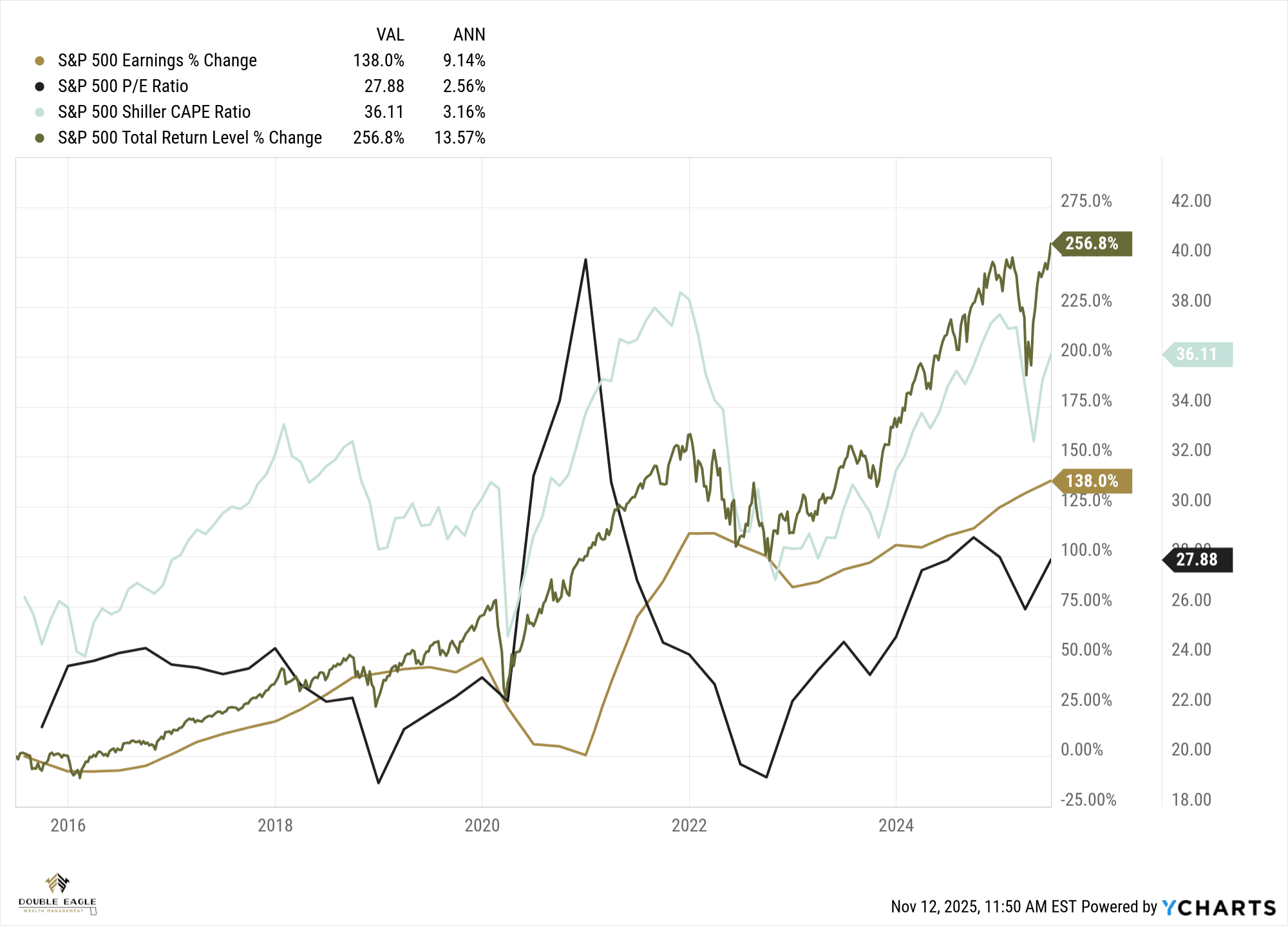
But, here’s what they leave out: earnings have grown 138% over the past decade. During that same period, the S&P’s P/E rose just 27%, and the CAPE 36%.
The story is not valuations, it’s earnings.
A New Economy Deserves New Multiples
We’re not a manufacturing economy anymore. We’re a services and technology economy, where margins and scalability are in another universe compared to the “old economy.”
In 1950, General Motors, arguably the best manufacturing company in America, earned an 11% profit margin. Today, NVIDIA’s sits around 52%. Apples and oranges.
When profit margins are factors higher, shouldn’t valuations be higher too anyway?
You can keep sounding smart telling everyone why the market’s overvalued or you can understand what’s really changed and make money.
Remember: the market doesn’t care about you.